

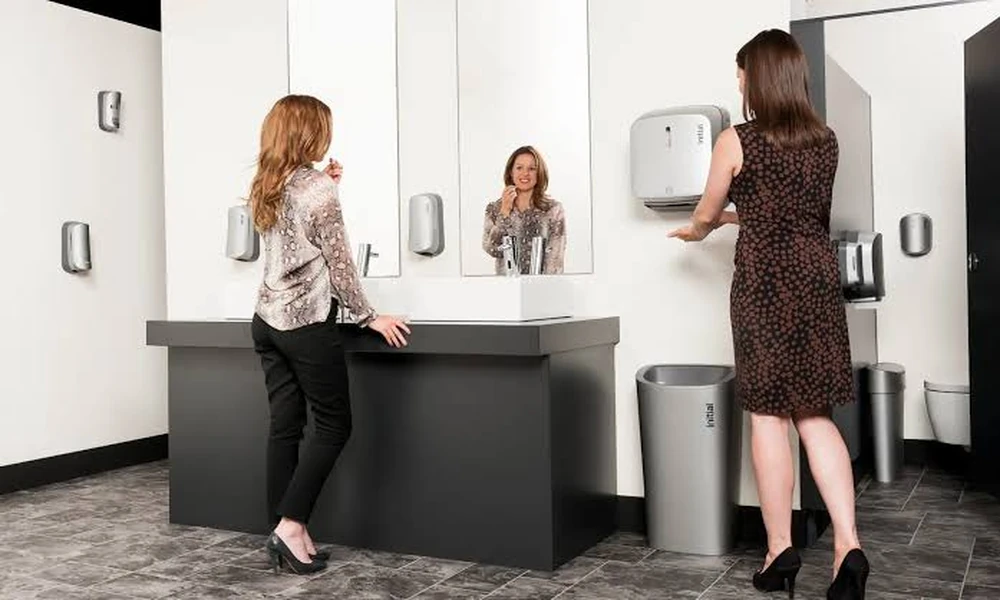
Touch-free accessories changed washroom hygiene planning by reducing the number of surfaces users must touch after washing their hands. Sensor-activated faucets, soap dispensers, paper towel dispensers, and hand dryers now appear in commercial restrooms across offices, schools, healthcare facilities, airports, and retail spaces.
Handwashing education can reduce the number of people who get sick with diarrhea by 23% to 40% (Centers for Disease Control and Prevention).
Why did touch-free accessories become widespread?
Touch-free accessories became widespread because facility owners and users increasingly prioritize hygiene and want to avoid touching shared surfaces in public restrooms. Reducing touchpoints after handwashing helps keep clean hands clean.
How touch-free fixtures support handwashing
Proper handwashing helps prevent the spread of germs (Centers for Disease Control and Prevention). Touch-free fixtures support that practice by limiting contact with faucets and dispensers during and after washing.
Common touch-free accessories
- Sensor-activated faucets
- Automatic soap dispensers
- Automatic paper towel dispensers
- Sensor-activated hand dryers
- Touch-free flush valves
- Hands-free waste receptacles
How integrated accessory lines support hygiene planning
Integrated accessory lines support hygiene planning when soap, water, and drying fixtures are designed to work together, and one manufacturer designs, engineers, and manufactures partitions, washroom accessories, lockers, and visual display products as integrated solutions (American Specialties, Inc.).
How do touch-free accessories affect the handwashing sequence?
Touch-free accessories affect the handwashing sequence by allowing users to dispense soap, run water, and dry hands without touching fixtures. Each step becomes contact-free.
Touch-free handwashing sequence
- Place hands under the soap dispenser for automatic dispensing
- Move hands under the faucet to activate water
- Rinse and step to the dryer or towel dispenser
- Dry hands without touching a lever or button
- Exit through a door designed to minimize contact
Facility planners can extend this approach to restroom exits with hands-free door hardware or doorless entries where layouts allow.
How should accessories be arranged for hygiene?
Accessories should be arranged so that users can move through the handwashing sequence in a logical order without crossing wet areas or reaching past other fixtures. Placement affects both hygiene and user experience.
Arrangement principles
- Place soap dispensers within easy reach of the faucet
- Position hand dryers or towel dispensers near sinks
- Avoid layouts that drip water across the floor
- Keep waste receptacles near drying stations
- Provide clear floor space for accessible use
Behind-the-mirror cabinets and integrated lavatory systems can consolidate soap, water, and drying at each sink, reducing water on floors and freeing wall space.
How do touch-free accessories affect accessibility?
Touch-free accessories can affect accessibility positively by reducing the need to grasp, twist, or press fixtures. Sensor activation helps users with limited hand strength or dexterity.
Placement and reach
Placement still matters. Accessories should be located within reach ranges and near accessible fixtures. Design teams should review applicable accessibility provisions for operable parts and reach ranges and confirm requirements with the authority having jurisdiction.
What maintenance considerations apply to touch-free accessories?
Maintenance considerations for touch-free accessories include battery or power management, sensor cleaning, refill scheduling, and troubleshooting. Automatic fixtures add electronic components that need attention.
Maintenance practices
- Check batteries or power connections on a schedule
- Clean sensors to maintain reliable activation
- Refill soap and towels before they run out
- Monitor dryers for proper airflow and operation
- Train staff to troubleshoot common issues
Empty dispensers undermine hygiene goals. Consistent refill routines are just as important as the fixtures themselves.
How do touch-free fixtures affect water and resource use?
Touch-free fixtures can affect water and resource use by controlling flow duration and dispensing measured amounts of soap and towels. Automatic shutoff prevents faucets from running unattended.
Water efficiency
Water-efficient products carry a federal label, and guidance is available for commercial facilities seeking to reduce water use (U.S. Environmental Protection Agency). Pairing touch-free operation with efficient fixtures supports both hygiene and conservation goals.
How should facilities choose between dryers and towels?
Facilities should choose between hand dryers and paper towels based on traffic volume, maintenance capacity, sustainability goals, and user preferences. Both options can support hygienic drying when properly maintained.
Decision factors
- Restroom traffic and peak demand
- Staff capacity for refilling and waste removal
- Sustainability and waste reduction goals
- Noise considerations in the surrounding space
- User expectations in the facility type
Some facilities provide both, allowing users to choose.
How do touch-free accessories fit into renovations?
Touch-free accessories fit into renovations as upgrades that can often be installed without major reconstruction. Battery-powered units reduce the need for new electrical work, while hardwired units may require coordination with electricians. Renovation projects should confirm wall backing, power availability, and plumbing compatibility before selecting fixtures.
How do touch-free accessories support different facility types?
Touch-free accessories support different facility types by addressing each setting’s specific priorities. Healthcare facilities emphasize infection prevention, schools emphasize durability and ease of use for children, and airports and stadiums emphasize speed and capacity during peak crowds.
Facility-specific priorities
- Healthcare facilities focus on minimizing contact and simplifying cleaning
- Schools focus on vandal resistance and reachable placement
- Transportation hubs focus on throughput during peak periods
- Offices focus on appearance and reliability
Matching accessory selection to facility priorities ensures touch-free features deliver their intended value.
Why is touch-free design now part of standard washroom planning?
Touch-free design is now part of standard washroom planning because users expect restrooms that minimize contact with shared surfaces. Facilities that meet that expectation improve user confidence and support better hygiene practices. Planning accessories as a coordinated, touch-free system gives users a cleaner experience from the moment they approach the sink to the moment they leave.
