

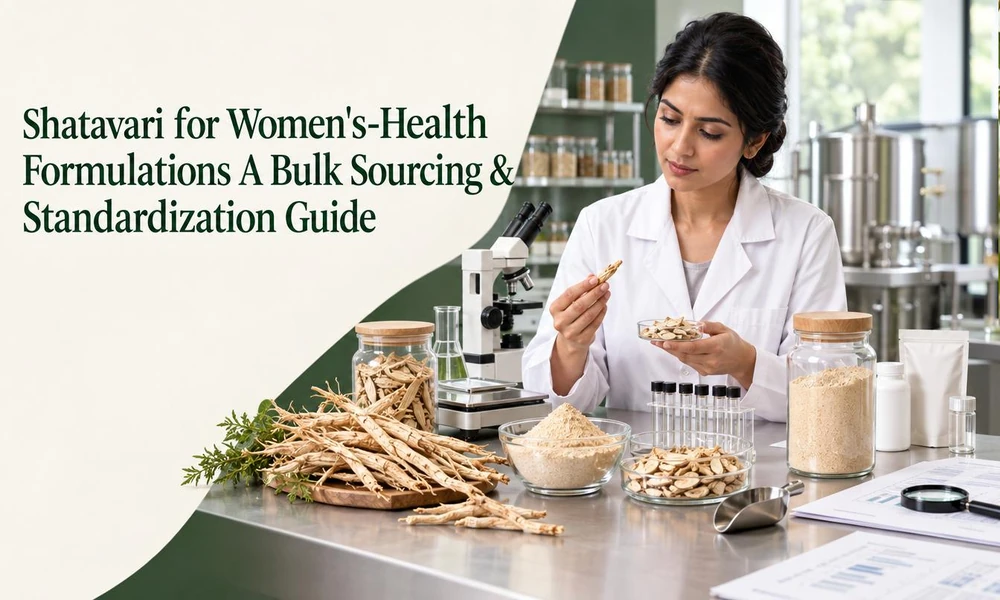
Shatavari at a Glance: Botanical Profile & Industrial Relevance
Shatavari has quietly become one of the most in-demand herbs in the women’s health space, and for good reason. For instance, the procurement department where shatavari is sourced is concerned with different questions than the purchasing department at a retailer. In the procurement sector, the focus is on understanding where the herb gets its consistency from, and how suppliers can verify it. This guide provides an overview of what is important for the transfer of asparagus racemosus raw material from an Ayurvedic root to a specification sheet.
Shatavari botanically is a perennial creeper herb that belongs to the Asparagus family and Shatavari is native to the Indian subcontinent and certain mountainous areas on the foothills of the Himalayan region where shatavari is valued because of its medicinal properties, particularly in Ayurvedic medicine. The roots of the plant are harvested when the plant is mature, which happens after about a year or two from the time of seeding. Therefore, the quick drying of the roots of shatavari is critical in terms of retaining the active ingredients through processing and storage.
Market Demand & Why Brands Are Sourcing It Now
The demand has not only increased but it has changed its focus as well. While shatavari was once only used in traditional Ayurvedic medications, it is now being used in popular women’s health capsules, hormone support blends, and lactation products across both Indian and Western markets. As brands seek organic shatavari wholesale in larger quantities, they are finding that certified organic supply finds the supply limited in comparison to common supplies, which encourages serious buyers to secure contracts before the harvest time than buy at spot-market prices later.
Key Actives: Shatavarins & Standardization
The shatavarins, which are steroidal saponins believed to be the main active ingredients of the root, are actually responsible for making the efficacy claims. Shatavari extract standardized shatavarins typically range from 10% to 40% shatavarins, depending on the extraction process; however, any buyer must not trust such claims unless they have been verified by HPLC results since spectrophotometric assays generally report a higher percentage.
Women’s-Health Category: The B2B Opportunity
The category itself is worth pausing on. The women’s health supplement market has transformed from being a niche market category to an actual growth category, and those formulators seeking to develop product lines revolving around hormonal balance, lactation support, or general wellness are looking for ingredient partners who understand the space, not just generic botanical vendors. Brands developing shatavari for women’s health supplements need suppliers who can speak to both the traditional use case and the modern clinical framing buyers expect on a label.
Formats for Formulation
The raw materials are available in multiple forms that can be used based on your manufacturing process. There is whole dried root, crushed granules, fine powder, and standardized extract either in powdered or concentrated liquid forms. Procuring Shatavari root granules will serve you well if you are operating tableting machines and capsule filling machines that require proper flow and dust-free operations, while finer powders suit blending into beverage or gummy bases.
Quality Specs & Documentation
An appropriate specification sheet is much more than a mere shatavarin percentage. It is important for the buyer to insist on obtaining details regarding moisture levels, particle size range, microbial counts, heavy metals screening and pesticide residues as a matter of course and not as additional information. Dealing with a shatavari root powder manufacturer who provides a complete Certificate of Analysis for each batch, as opposed to an off-the-shelf certificate used for all batches, often helps in identifying sincere suppliers from opportunistic ones fast.
Certifications & Compliance
Documentation carries real weight in this category, arguably more than most botanicals given how women’s-health claims get scrutinized. A certified shatavari root bulk supplier must be able to offer organic certification where applicable, traceability to the origin of the product, and lab test results for the specific lot that is being sent out and not for a previous lot taken long ago.
Applications
Apart from capsules and tablets, shatavari for supplement manufacturing can be incorporated into several other supplement and wellness formats, depending on the formulation requirements, target market, and applicable regulatory standards. Common applications include:
- Functional beverages: Shatavari can be used in formulations of functional drinks beverage
- Shatavari can be used in developing functional drinks.
- Powdered sachets: Shatavari is also appropriate for powder sachet packaging.
- Blend formulations: Shatavari can be combined with other adaptogens, such as ashwagandha.
- Traditional formulations: Shatavari-Ashoka blends are used in traditional formulations.
- Moderate flavor: It has a fairly moderate flavor that allows for its use in drinks without impacting the taste of the other drinks when mixed with them.
How to Evaluate a Bulk Shatavari Supplier
Vetting a bulk shatavari root powder supplier properly takes more than comparing quotes side by side. A few things worth confirming before signing a purchase order:
- Identify the part of the plant and harvesting season for the source of your material.
- Request a recent Certificate of Analysis showing actual shatavarin percentage via HPLC.
- Test for heavy metals, pesticide residues, and microbial tests for all the incoming shipments.
- Specify minimum order quantity, lead times and sample availability in advance.
The supplier that can answer these questions with no difficulty is one to consider developing further business relations with.
Frequently Asked Questions
Q: Can you supply shatavari standardized to a specific shatavarin percentage?
A: Yes, standardization will generally be between 10% and 40% shatavarins based on the method of extraction. You should always ask for HPLC data instead of a spectrophotometric approximation.
Q: Which formats suit women’s-health capsules, tablets and functional beverages?
A: Powders and granules will perform well for capsules or tablets; while standardized liquid or soluble powder extract formulations will be appropriate for drinks, because they mix smoothly without heavy sediments.
Q: Is your shatavari certified organic and traceable to source?
A: Organic-certified lots are provided with documentation that trace the origin of the material from the specified growing region of production during a certain harvesting period, building trust among consumers about authenticity of the supply chain.
Q: What documentation do you provide to support claim-safe product development?
A: A detailed Certificate of Analysis for shatavarin percentage, moisture, microbial levels, heavy metals, and pesticides on each batch, not just some generic reused certificate.
Q: What are the MOQ and lead times for bulk shatavari?
A: It depends on the supplier, the season when harvesting is done, and level of standardization. Verify the minimum order quantity and the lead time, and take samples before placing a large order.
Partner With a Certified Shatavari Supplier
The selection of the appropriate shatavari supplier is based on the same principles as any serious ingredient sourcing process: valid actives information, reliable availability throughout the harvest period, and regulatory-defensible documentation. Those buyers who ensure such a screening as an initial step in their process do not incur the costs associated with formulation delays and labeling disputes, which are significantly more expensive than even a modestly higher price per kilo.
